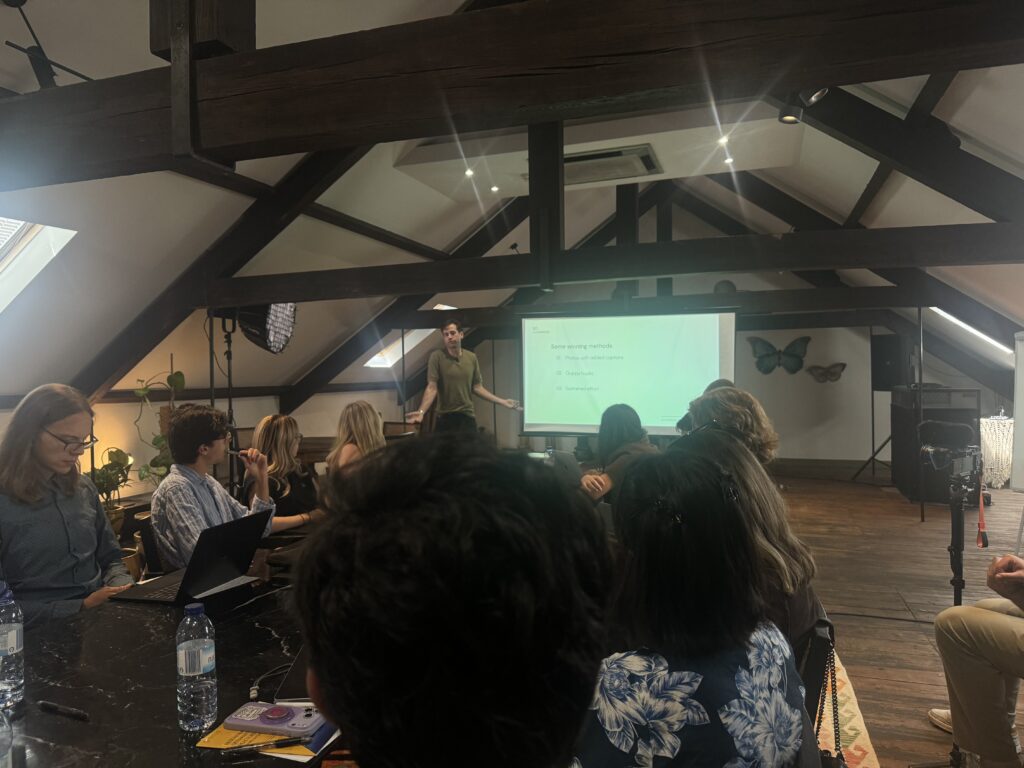


The Nuclear Champions Retreat in Lisbon brought together people from 12 countries who were working on different parts of the nuclear conversation. The event, organized by Stand Up for Nuclear, included engineers, policy specialists, campaigners, communicators and people involved in local advocacy. Much of the two and a half days was built around working discussions, and I attended with a Japanese science colleague. Together, we contributed Japan’s perspective throughout the retreat, including how nuclear policy is developing, how public opinion has changed, and how the Fukushima accident still shapes the way the subject is discussed.
I spent a lot of time explaining Japan and comparing our situation with what people from Europe and North America were dealing with in their own countries. Some were working with politicians, some with journalists, some with local communities and some around specific nuclear plants. The conversations were practical. People talked about what they had tried, who they had managed to reach, and where they were still having trouble getting through.
Ireland provided one of the clearest examples. The group 18for0, co-founded by Sarah Cullen, grew out of research into replacement options for the 915 MW Moneypoint coal plant in western Ireland. Its early work was heavily technical, including a report that eventually reached around 40 to 50 pages. The group wanted to show that nuclear deserved serious consideration in a country where it had very little place in the energy debate.
Over time, the group put more effort into meeting people directly. Members attended environmental gatherings, community events and political meetings, and built relationships with people who came to the subject from very different starting points. Those relationships led to introductions, speaking opportunities and meetings that were hard to create through reports alone. In one example discussed at the retreat, a short one-page brief passed through a trusted political contact reached the right people more effectively than a large public workshop.
That stayed with me because nuclear discussions can become technical very quickly. Most people are not reading energy reports or following reactor policy. They are thinking about climate change, electricity bills, jobs, whether the lights will stay on, and what kind of energy system their children will live with. If nuclear is part of that future, people need to be able to understand why in normal language.
A Norwegian pro-nuclear organisation had deliberately built relationships across conservative, green and labour circles, including youth politicians and environmentalists. The organisers wanted nuclear to be something people from different political backgrounds could discuss seriously. They also found that people came to the issue for different reasons. Climate mattered in some conversations. Energy security, jobs, industry and electricity prices mattered more in others.
When the discussion turned to political support, I explained how things work in Japan. People asked why local approval can take years, how much public opinion has changed and how strongly 2011 still shapes the debate. I talked about the role of local communities, regulators, utilities and national politics, and how a decision in Tokyo does not automatically mean a reactor restarts soon after.
The Danish experience showed what a relatively small organisation can achieve if it keeps showing up. One Danish organiser described a group with around 1,000 paying members, an annual budget of roughly €40,000 and only 10 to 20 active volunteers at major events. The group had still become highly visible through political festivals, media appearances, educational work, cultural events and regular contact with journalists.
Their media approach was straightforward. Organisers looked for journalists who were already interested in energy, learned what they covered and gave them useful material they could work with. A good relationship with one journalist could lead to more serious coverage and better questions. That kind of work takes time, and several people at the retreat said it became more valuable as those relationships grew.
Public events created another kind of contact. Danish organisers attended festivals and political gatherings with highly visible branding. Irish participants talked about spending time in environmental communities and meeting people face to face. Those settings gave people room to ask simple questions, raise concerns and come back later. The conversation could start with something as basic as electricity prices or climate and move from there.
The discussion around Diablo Canyon in California made a similar point. One organiser described a visible core of around 120 supporters at one stage of the campaign. The wider coalition included local officials, workers, tribal representatives, nonprofits, journalists, women advocates and people from industry. The campaign became stronger because people with different connections to the plant and the local area were speaking in their own voices.
Who speaks matters. A local business owner can talk about jobs. Someone living near a plant can speak from direct experience. A worker can explain what the facility means to the local economy. A scientist can answer technical questions. A young person may connect the issue to climate and the future. People tend to listen differently depending on who they are hearing from.
I was asked several times how that works in Japan. Who do people listen to? Which voices carry weight? How much influence comes from local leaders, experts, utilities, regulators, media and politicians? Those questions made me think about how often nuclear in Japan is still discussed mainly by people already inside the energy world.
Japan has many capable engineers, regulators, academics and industry specialists who have spent years working on safety and energy policy. There are also younger people, local businesses, residents near nuclear facilities, people working in regional communities and people who simply care about climate and reliable energy. Hearing more from those people could make the subject easier to connect with everyday life.
Another useful point from the retreat was that big national opinion polls do not tell you where every decision is actually made. A political party may have only a handful of people writing its energy policy. A reactor restart involves regulators, local governments, utilities and the communities around the plant. A newspaper story may depend on one editor deciding that the subject deserves attention. Several participants talked about using short briefs, private meetings, site visits and direct introductions to reach the people who were actually involved.
The practical side of building these organisations was often simple. People used the skills they already had. Engineers helped with technical questions. Lawyers helped with policy. Designers made information easier to understand. People who knew local communities helped organise events and make introductions. New supporters were given small ways to get involved, and organisers stressed the importance of following up when someone showed interest.
I kept comparing these examples with Japan throughout the retreat. Some ideas seemed easy to use here. Others would need to be changed quite a bit. Relationships, reputation and careful communication carry a lot of weight in Japan, especially around nuclear energy. Any approach here has to fit the way people actually talk, make decisions and build trust.
The people I met in Lisbon had spent years writing reports, organising events, meeting politicians, speaking with journalists and building relationships in local communities. Progress often came through small developments: a journalist becoming interested, a politician agreeing to meet, an environmental group becoming more open to discussion, or a local organisation deciding to take part.
Presenting Japan’s situation in those discussions gave me a chance to test our experience against what others had seen in their own countries. I came back with a stronger sense that Japan’s nuclear conversation can become wider and more understandable without losing the serious technical work behind it. More people can be part of that discussion, especially people who care about climate, energy security, local jobs and the future of their communities.
That is where I think the opportunity is. Nuclear affects issues that ordinary people already care about. The more clearly those connections are explained, and the more people from different parts of society take part, the easier it becomes to have a serious conversation about what role nuclear should play in Japan.