

In August 2025, nearly 4.3 million people in Taiwan voted in favor of restarting the Maanshan nuclear power plant. That was 74% of the valid votes cast, yet the referendum failed. Taiwan’s rules required affirmative votes from at least 25% of all eligible voters, and the proposal fell short.
I used this example when I spoke at the Small Modular Reactor and Microreactor Forum in Taipei this October. Through my nuclear advocacy work in Japan, I’ve spent a lot of time thinking about how public support translates into actual decisions. Taiwan’s referendum brought that question into sharp focus.
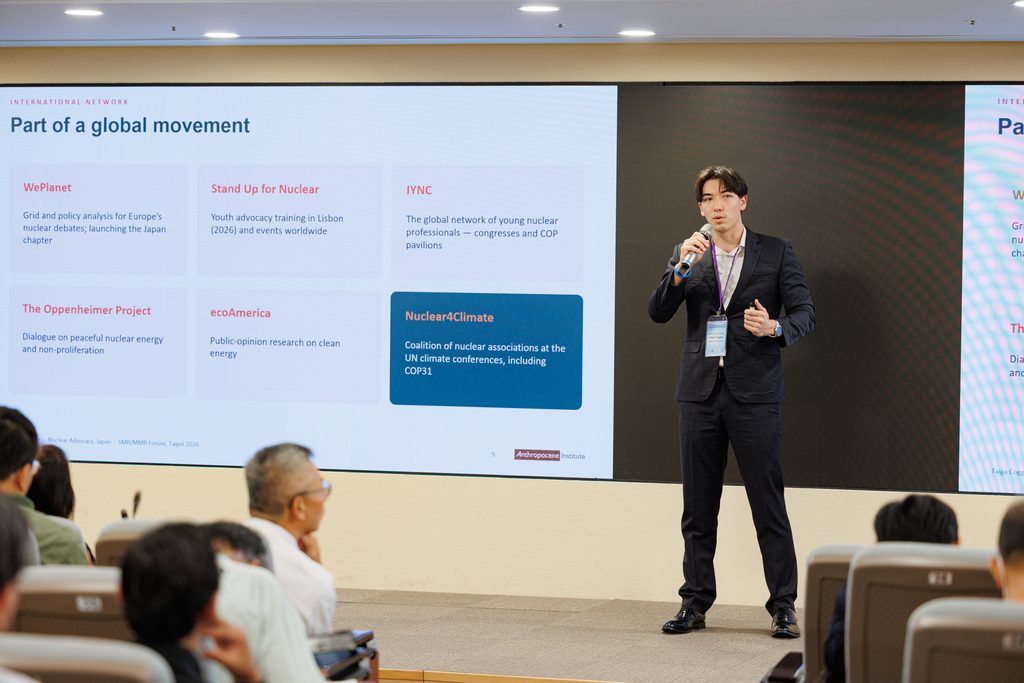
My presentation, Changing Minds: Public Support for a Nuclear Renaissance, was part of a forum attended by researchers, engineers, and industry representatives discussing new reactor technologies, manufacturing, and Taiwan’s nuclear future. I was representing the Anthropocene Institute, bringing public opinion into a discussion largely focused on the technical and practical challenges of nuclear development.
A reactor can be designed, tested, and ready for deployment, but getting it built involves communities, voters, regulators, and political leaders. Public support needs to be active and visible. Taiwan’s referendum was a powerful example of what can happen when that participation falls short.
Maanshan Unit 1 closed in July 2024, followed by Unit 2 in May 2025, bringing an end to nuclear electricity generation in Taiwan. Three months later came the referendum. The debate continued, and in March 2026, Taiwan Power Company submitted plans to restart Maanshan. Regulators completed their review of the restart plan in September, with further safety assessments required before the plant can operate again.
The PACE international energy survey, conducted by Radiant Energy Group and co-sponsored by the Anthropocene Institute in 2024, found that 56% of Taiwanese respondents supported nuclear power, compared with 22% who opposed it. This suggests considerable interest in nuclear energy, even in a country that had committed to phasing it out. People can support nuclear power generally and still have reservations about restarting an existing reactor, particularly when questions about its condition, safety, and long-term costs are involved.
In Japan, the public conversation has also been changing. An Asahi Shimbun poll in February 2026 found that 51% of respondents supported restarting idled reactors, with support reaching 66% among people aged 18 to 29. Among women, the figure was 39%, showing how differently people can view the same issue.
Through my work with students and young professionals, I’ve met many people who want to understand how nuclear energy fits into questions about climate change, electricity prices, and energy security. These issues are already affecting our lives, and younger generations will live with the consequences of today’s energy decisions for decades.
Japan also carries the experience of the Fukushima accident. For many people, confidence in nuclear energy is closely tied to confidence in the organizations responsible for operating and regulating it. The recent shift in public support is significant, though attitudes remain fragile.
At the Taipei forum, Professor Gao Ming-zhi of National Tsing Hua University raised a related issue during his presentation on energy policy and regulation. He described how public consultations can involve an hour of explanation from government officials, followed by perhaps twenty minutes for questions. People who have traveled to attend may have very little opportunity to speak. His proposal for wider online consultation would give more people a chance to contribute, including those unable to attend in person.
It was a useful connection to my own presentation. Encouraging people to participate means giving them a genuine opportunity to do so, and making the information available in a form they can work with.
Save Maanshan is one example of this approach. Developed by the Anthropocene Institute’s data science team, the online tracker uses Taiwan Power Company’s generation data to estimate the impact of replacing Maanshan Unit 1’s nuclear output with fossil fuels. By October 9, the project’s estimate of additional carbon dioxide emissions had reached 28.3 million tonnes, based on its modeling assumptions.
The Institute has also partnered with the climate platform We Don’t Have Time on a six-part video series explaining how nuclear power plants are developed and operated. Each episode features people involved in the process, from reactor design and licensing to financing, construction, fuel, and daily operations.
There is plenty of scope for Taiwan and Japan to cooperate on this kind of work. Both countries depend heavily on imported energy and have industries that need reliable electricity. Their experiences with nuclear policy and public opinion also offer opportunities to learn from one another.
During my presentation, I proposed joint public-opinion research, student exchanges, visits to nuclear facilities, and translating Got Nuclear educational content into Traditional Chinese. These are projects that could begin bringing people together long before any new reactors are built.
I’d particularly like to see young people from Taiwan and Japan visiting nuclear facilities together, meeting the people who work there, and having the freedom to ask their own questions. The connections made in Taipei give us a place to start, and I hope we can turn them into opportunities for more people to experience nuclear energy firsthand.