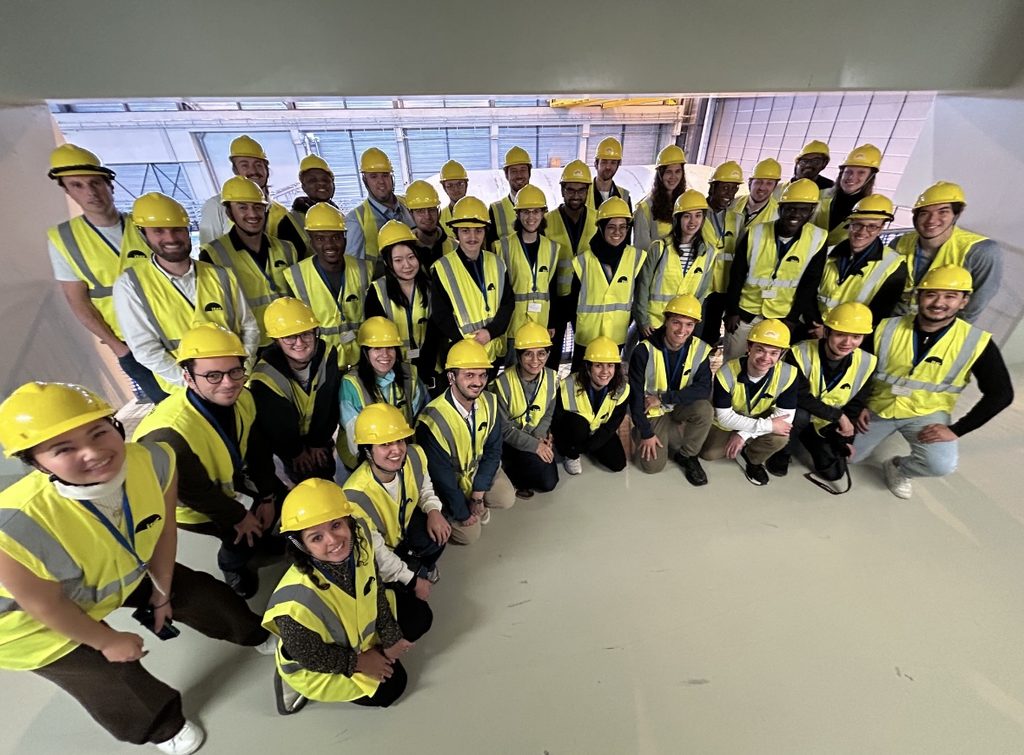


When I visited ITER in southern France during the International Youth Nuclear Congress in October 2026, six of the nine enormous steel sections that will form the core of its fusion machine were already in the assembly pit. Our group could not enter the main assembly hall because we did not have the protective equipment required for that area. From the bus, we could see the power-supply buildings, the large tanks of the cryogenic plant that helps cool ITER’s superconducting magnets, the assembly hall behind them and the reactor building in front.
Fusion is often discussed as a possible future source of low-carbon electricity. ITER has a specific job within that much bigger ambition: test whether a large fusion plasma can be created and controlled under conditions relevant to future power plants. Plasma is an extremely hot, electrically charged gas, and powerful magnets are used to keep it confined inside the machine.
The target is called Q=10. ITER is designed so that 50 megawatts of external heating delivered to the plasma would produce 500 megawatts of fusion power. Researchers want to reach a state known as a burning plasma, where the fusion reactions themselves provide much of the heat needed to keep the plasma going. The 500-megawatt figure describes the fusion power produced inside the plasma. Electricity generation belongs to the power plants that could eventually follow ITER.
The explanation of ITER’s size that worked best for me involved a wood-fired pizza oven. Imagine building one for a single miniature slice. It would lose too much heat. Make the oven enormous and controlling the heat creates a different problem. A fusion plasma also has a relationship between its size, the heat it loses and how effectively that heat can be contained. ITER was designed at the scale researchers believe is needed to reach Q=10.
Later, the process of starting the machine was described in a few steps. Inject a couple of grams of gas, bring up the magnetic fields, switch on the heating systems and create the plasma. The speaker paused and added, “Sounds easy, right?”
One reason it is so difficult comes from the neutrons produced during fusion. Neutrons have no electrical charge, so the magnetic fields that confine the plasma cannot hold them. They leave the plasma carrying large amounts of energy and strike the materials surrounding it. A future fusion power plant would capture that energy as heat and use it to produce electricity, which means the materials closest to the plasma would also have to withstand years of intense neutron bombardment.
Researchers are still working on which materials can survive those conditions for the lifetime expected of a commercial reactor. During the presentation, we heard about a facility being developed in Granada, Spain, to expose candidate materials to intense neutron radiation and study how they behave. The materials surrounding a future fusion reactor remain one of the engineering problems still being worked through.
The fuel discussion brought another useful reality check. Deuterium, one of the forms of hydrogen used in fusion, occurs naturally in water. A physicist used a striking comparison involving the lithium in a laptop battery and deuterium from water to illustrate how much energy the atoms could theoretically contain. The qualification came immediately: counting atoms is one thing; turning them into a working industrial fuel system is another. Future deuterium-tritium fusion plants would also need a reliable way to produce and manage the tritium they consume.
A few months before my visit, on 28 July, engineers had lowered the sixth of ITER’s nine huge sector modules into the assembly pit. The module itself weighed about 1,100 tonnes, and the suspended load approached 1,400 tonnes once the lifting equipment was included. The operation took around 30 hours. By the time our bus passed the assembly hall in October, that enormous piece of the machine was already inside.
Putting those numbers next to the fuel gives a strange sense of the scale of ITER. Thousand-tonne components, superconducting magnets and huge cooling systems are being assembled to run experiments using only a few grams of gas at a time.
Much of the machine is already in the pit, and the experiment those pieces were built for still lies ahead. ITER’s job is to show whether fusion can work technically at this scale. Turning that result into a power plant will be another project.