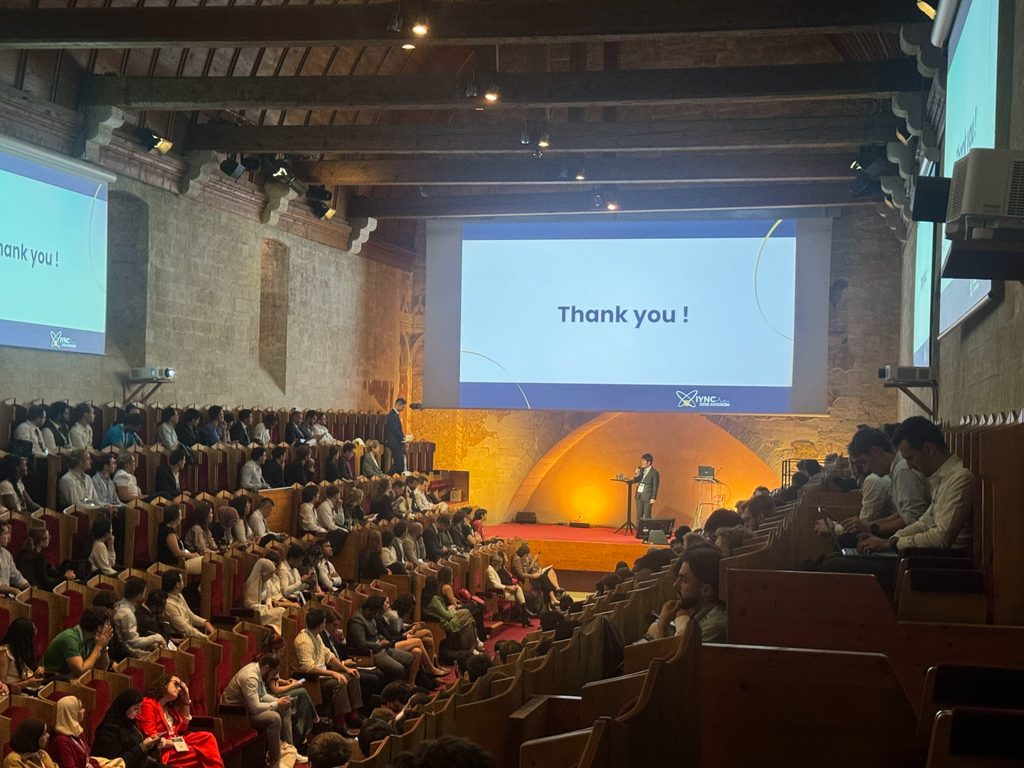


Halfway through a panel in Avignon, Alice Cunha da Silva, a Brazilian nuclear engineer and vice president of the International Youth Nuclear Congress, asked the room for a show of hands.
How many people came from countries with nuclear power plants? Hands went up across the room. Then she asked how many could name one or two important ecosystems in their own countries. Fewer hands went up. From there, she turned the discussion toward a harder question: how well do people working in nuclear understand the environments and communities where their projects actually exist?
The exercise took only a few minutes, but it captured one of the central questions running through the week.
I was in Avignon, France, representing Japan at the International Youth Nuclear Congress, held this year inside the Palais des Papes. More than 500 students and young professionals from over 50 countries came together to discuss nuclear energy and the responsibilities our generation will inherit. The conversations ranged from reactor technology and fuel supply to climate policy, financing, public trust and the practical challenge of building projects in places where people already live, work and have their own history with energy.
Nuclear professionals spend years learning how reactors work. The decisions surrounding nuclear energy extend much further. They involve land, water, biodiversity, local employment, indigenous communities, financing, regulation and public confidence. Alice’s point was that the industry needs people who understand those connections as well as the technology itself.
The distance between technical evidence and human experience came up repeatedly. Alice described conversations with people in Germany who grew up after Chernobyl and remembered Geiger counters being used to check bread and milk. Decades later, those memories still influence the way some of them see nuclear energy. Technical evidence can explain risk and safety in great detail. Personal experience enters the conversation through a completely different door.
Jadwiga Najder, coordinator of Nuclear for Climate, made the same point in very ordinary language. When someone raises a concern about nuclear, she said, that person is probably not asking for a “wall of numbers.” The question may come from years of headlines without much context, something heard from family, or a worry that has never been answered clearly. Good communication begins by understanding why the question is being asked.
That has particular relevance in Japan. Our nuclear conversation carries the experience of the Fukushima accident alongside questions about radioactive waste, electricity prices and energy security. Japan imports most of the energy resources that support its economy, and events thousands of kilometres away can affect the price and availability of the energy we use at home. People weigh these issues differently, shaped by where they live and what they have experienced.
The discussion in Avignon then moved from communication into the way projects are developed. Alice spoke about infrastructure projects in Brazil that faced serious protests after communities felt excluded from decisions affecting them. Early engagement with environmental and community concerns can influence construction schedules, costs and ultimately whether investors believe a project can be completed. In that sense, public trust becomes part of project delivery itself.
An Orano executive gave the uranium industry’s perspective. Mining projects require relationships with communities long before extraction begins and for years after production ends. He described local employment and benefit sharing in northern Saskatchewan, including agreements involving indigenous communities. He also gave the example of a former Canadian uranium site where years of environmental monitoring and restoration eventually allowed the land to be returned to nature.
The industrial scale involved is significant. Orano is expanding enrichment capacity at its Georges Besse II facility in France by 30 percent through a €1.7 billion project. Its planned enrichment project in Tennessee has also received a $900 million award from the US Department of Energy. Investment at that level reflects expectations of growing nuclear demand and brings more mines, facilities, communities and governments into the same chain.
Alice later shared a story from another conference in Santa Marta, Colombia. She met a Brazilian who had led opposition to the Santa Quitéria uranium-mining project. They began talking socially, eventually discovered how far apart they were on nuclear energy and continued the conversation anyway. They remain in contact. His position did not suddenly change, and the value of the encounter came from understanding more clearly where each person was coming from.
Jadwiga took that idea further near the end of the session. Nuclear advocates do not need to convince every person that nuclear is the safest and best energy source everywhere. She mentioned Costa Rica as an example of a country whose natural conditions may make nuclear less relevant. The stronger case is that nuclear can be safe, useful and extremely valuable in energy systems that need what it provides.
The hardest question of the session came from a participant from Ghana. He asked what another serious nuclear accident would mean for the industry and whether it could again slow nuclear development around the world.
The answers were unusually open. Jadwiga referred to a phrase she has heard from experienced people in the industry: “not if, but when.” Her point was that no complex technology can assume accidents or incidents will disappear forever, which makes preparedness and accountability essential. Other panelists acknowledged that a serious accident would affect public confidence and nuclear projects far beyond the country where it occurred. The discussion covered emergency preparedness, safety culture, transparency and the responsibility to communicate honestly with affected communities.
For someone representing Japan, that exchange carries weight. We know how far the effects of a nuclear accident can travel through public confidence, energy policy and decisions made many years later. We also know that the underlying questions about how Japan powers its economy continue long after the immediate crisis has passed.
Avignon was full of confidence about nuclear’s future. Countries are considering new reactors, fuel-cycle investment is expanding, electricity demand is rising and a new generation is entering an industry preparing for significant growth. The young people gathered at IYNC will spend much of their careers turning that momentum into real projects.
Alice’s show of hands captured an important part of what that will require. Deep knowledge of nuclear technology remains essential. Building nuclear successfully also requires understanding the places where the technology will operate; their environment, history, people and concerns. The future of nuclear energy will be shaped by both.