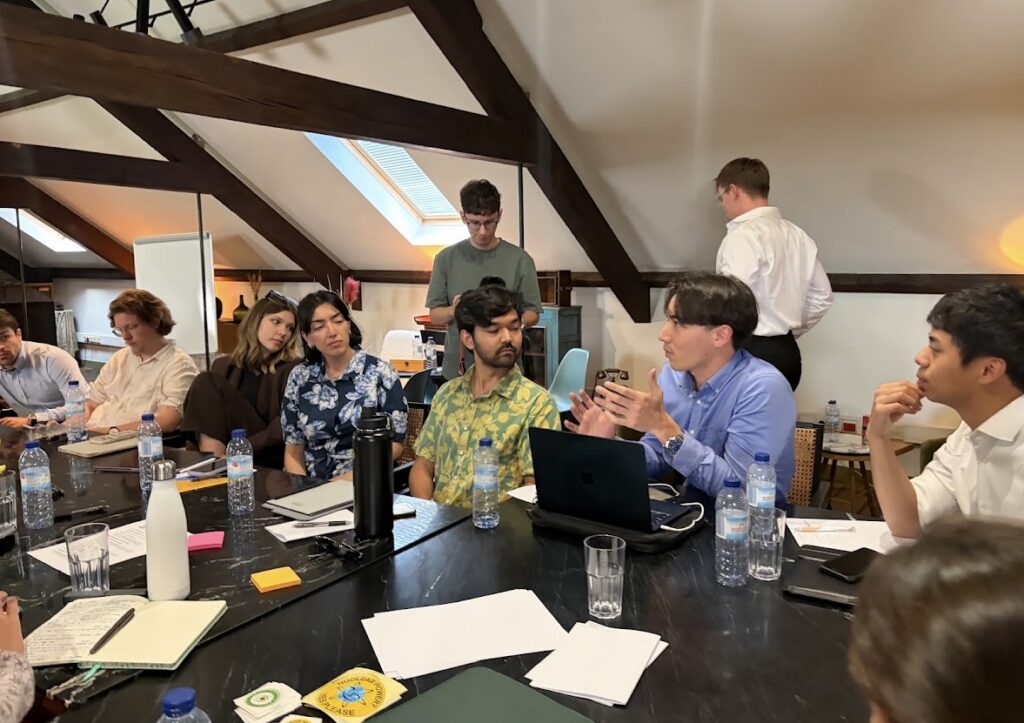


I travelled from Japan to Lisbon for an event called the Nuclear Champions Retreat, organized by Stand Up for Nuclear. It was the first gathering of its kind: two and a half days, 17 participants, 10 speakers and people from 12 countries across Europe, North America and Asia. The program covered grassroots organizing, public communication and energy policy, with much of the exchange happening in working sessions, small groups and the conversations that continued between them. I was there representing Japan’s perspective, speaking about our energy policy, answering questions about nuclear power at home and learning how the same issues are being handled in countries with very different histories.
The differences between countries became vivid once people started explaining what they were actually dealing with. Norwegian advocates described efforts to build support for nuclear among conservatives, greens, labour politicians, young people and environmentalists. Their strategy was to create support broad enough to survive elections and changes of government. Denmark came from a very different history. Wind power has become closely associated with the country’s environmental identity, and its parliament excluded nuclear from national energy planning in 1985. Public opinion has been moving significantly in recent years, with polling presented at the retreat showing support for building nuclear in Denmark rising from around 17% in 2016 to roughly 55% by early 2025.
Ireland has never operated commercial nuclear power, and legislation has constrained its development, so advocates there have spent years trying to create a serious space for the subject among journalists, politicians and environmental groups. Germany brought decades of political history into the room. Its final three reactors closed on 15 April 2023, following a long phase-out shaped by anti-nuclear movements, party politics and Germany’s wider energy transition.
Portugal gave the discussions another layer because the country itself has pursued a strongly renewable electricity strategy built around hydro, wind and increasingly solar. The International Energy Agency’s 2026 review describes Portugal as having one of the lowest-carbon electricity systems among IEA member countries. It also points to growing pressure on transmission and distribution networks as renewable capacity and electrification expand. Distributed solar alone had reached 3.1 GW by the beginning of 2026, and the IEA has warned that grid constraints could lead to increasing curtailment and slower connections unless investment in networks and flexibility keeps pace.
Japan attracted a great deal of curiosity in Lisbon. People wanted to know which political parties support reactor restarts, where resistance remains, how public opinion has changed, why restarting a reactor can take so long, and how strongly the Fukushima accident still shapes the language around energy policy. We talked about local consent, regulation, energy security and the gap that can exist between national policy and what is possible at a particular site.
Those conversations required some explanation because Japan’s position is difficult to reduce to a single political label. Our current energy policy envisages nuclear supplying around 20% of electricity in FY2040 and renewables supplying 40–50%. The government also calls for restarting reactors after their safety is confirmed and for development of next-generation advanced reactors. Turning those percentages into reality involves regulators, local communities, utilities, investment, transmission and a political environment that still carries the experience of 2011 very closely.
The cultural differences in Lisbon were just as noticeable as the policy differences. Some participants spoke very openly about campaigning, party politics, public pressure and how politicians can be persuaded to change position. Others came from engineering, economics or environmental backgrounds and approached nuclear through electricity prices, industrial competitiveness, land use or emissions. Japanese discussions around nuclear frequently move with greater caution, particularly when public safety, local communities and the Fukushima accident are involved. Sitting around the same table with people who communicated so differently made it much easier to see how strongly energy debates are shaped by national culture.
Electricity markets took up a large part of the discussion, especially when Germany and Denmark came up. Germany recorded 573 hours of negative wholesale electricity prices in 2025, up from 457 hours in 2024. Prices were therefore below zero for about 6.5% of all hours in the year. At the same time, Germany’s average day-ahead wholesale price rose from €78.51 per megawatt-hour in 2024 to €89.32 in 2025. A system can experience hundreds of hours with excess electricity and still end the year with a relatively high average wholesale price.
Germany also spent around €3.06 billion in 2025 on redispatch and reserve measures used to deal with network congestion and maintain balance on the grid. These figures gave the discussion a practical edge because they showed what happens once large amounts of generation have to work inside a real electricity system with physical limits.
Wind and solar can produce very large amounts of low-carbon electricity when conditions are favourable. Across the European Union, wind and solar together supplied around 30% of electricity in 2025. When large amounts of generation arrive at the same time, the system has to absorb that electricity somehow. Demand can take some of it. Transmission can move electricity to another region. Batteries can charge. Industrial users can shift some consumption into cheaper hours. Grid operators can also curtail generation when there is more electricity available than the system can use.
Contracts for Difference, or CFDs, were one subject discussed in Lisbon. These contracts give generators an agreed strike price and create more predictable revenues around volatile electricity markets. Curtailment complicates the picture because a generator may be physically capable of producing electricity and then be instructed to reduce output for system reasons. The financial treatment varies between markets and contracts, which means the design of those systems matters as much as the headline capacity being built.
Batteries can absorb surplus electricity and release it when demand and prices rise. Their commercial value partly comes from the difference between cheap and expensive periods. Large numbers of batteries responding to similar price signals can narrow those differences over time, which changes the economics of additional storage. Their usefulness also depends on duration, location, charging patterns and the particular services the grid needs from them.
Transmission has its own economics. Renewable resources are often strongest far from the largest centres of demand, so large buildouts can require major network investment. Portugal is already facing this as solar and electrification grow. Germany has dealt with the same issue on a much larger scale, with substantial generation in the north and heavy industrial demand farther south. The generating plant is only one part of the infrastructure required to deliver usable electricity.
Existing nuclear plants fit into this system in a different way. A plant that is already connected to the grid has a site, transmission connection, workforce and supporting infrastructure that took years and large amounts of capital to establish. Closing that plant removes a source of dependable electricity that then has to be replaced elsewhere in the system.
The replacement may involve new generating capacity, additional transmission, storage, demand flexibility and firm generation for periods when weather-dependent supply is low. Geography determines how difficult that becomes. Norway has enormous hydro resources. Denmark has excellent wind conditions and strong interconnections with neighbouring electricity systems. Portugal has hydro, wind, solar and access to the wider Iberian market. Japan has a very different geography and far fewer physical connections with neighbouring countries.
Japan is an island system with limited domestic fossil-fuel resources and relatively little flat land. Our economy includes energy-intensive manufacturing, densely populated metropolitan areas and industries that depend on reliable power. Future electricity demand will also be affected by data centres, artificial intelligence, electrification and the continued expansion of digital infrastructure.
Japan’s FY2040 outlook places nuclear at around 20% of electricity generation, alongside 40–50% renewables and 30–40% thermal power. Reaching the nuclear figure would require a major expansion from today’s operating fleet. As of early 2026, 15 reactors were operating nationwide.
Independent projections show how demanding the government target could be. The Renewable Energy Institute, which advocates a much larger role for renewable energy, published updated scenarios in April 2026. Only its Maximum scenario reaches 20% nuclear in FY2040. That case assumes nearly all existing and planned reactors enter service, reactors are allowed to operate beyond 60 years, and the fleet achieves an 85% capacity factor. The recent operating average for restarted Japanese reactors was 73.7%, and the oldest operating reactor anywhere in the world is currently 56 years old.
The remaining reactors are at very different stages. Some have cleared regulatory reviews and are preparing for operation. Others remain under assessment or face major technical and regulatory obstacles. Tsuruga Unit 2 is a clear example. Japan’s Nuclear Regulation Authority rejected its restart application in November 2024 after concluding that it could not rule out an active fault connected to a fracture zone beneath the reactor building.
The government’s 20% figure therefore gives Japan a clear policy direction, and the final outcome will depend on how many reactors can clear regulation and return to service, how much renewable capacity can be built and connected, how transmission and storage develop, and how electricity demand changes over the next decade and a half. The same practical questions apply across every part of the future energy mix.
Spending several days with people working on energy policy in such different countries made it much easier to see how strongly each electricity system reflects choices made over decades. Denmark has built an energy system and a national identity around wind. Germany is managing very high renewable penetration after completing its nuclear phase-out. Norway benefits from hydro resources that give it options few countries possess. Portugal is continuing to expand renewables as its grid begins to face the pressures that come with that growth. Japan enters the same discussion with limited domestic energy resources, substantial nuclear infrastructure, difficult regulatory and local-consent questions, and an electricity system with very few physical connections beyond its own borders.
The conversations in Lisbon were useful because people could compare systems that had already been built and policies that had already been tested. A target of 20%, 40% or 50% looks straightforward in an energy plan, yet reaching it requires reactors to clear regulation and operate reliably, renewable projects to find land and grid connections, storage to provide the services the system needs, and networks to carry electricity from where it is produced to where it is consumed. All of this has to happen as demand itself changes.
Japan will make its own choices over the coming years, and the experience of other countries gives us a much wider view of what those choices can lead to in practice. Their examples show how quickly an energy target becomes a question of engineering, economics, geography, politics and public confidence once construction begins and electricity has to move through a real grid. Those are the questions that will shape Japan’s energy system long after the percentages in today’s plans have been replaced by the infrastructure we actually build.