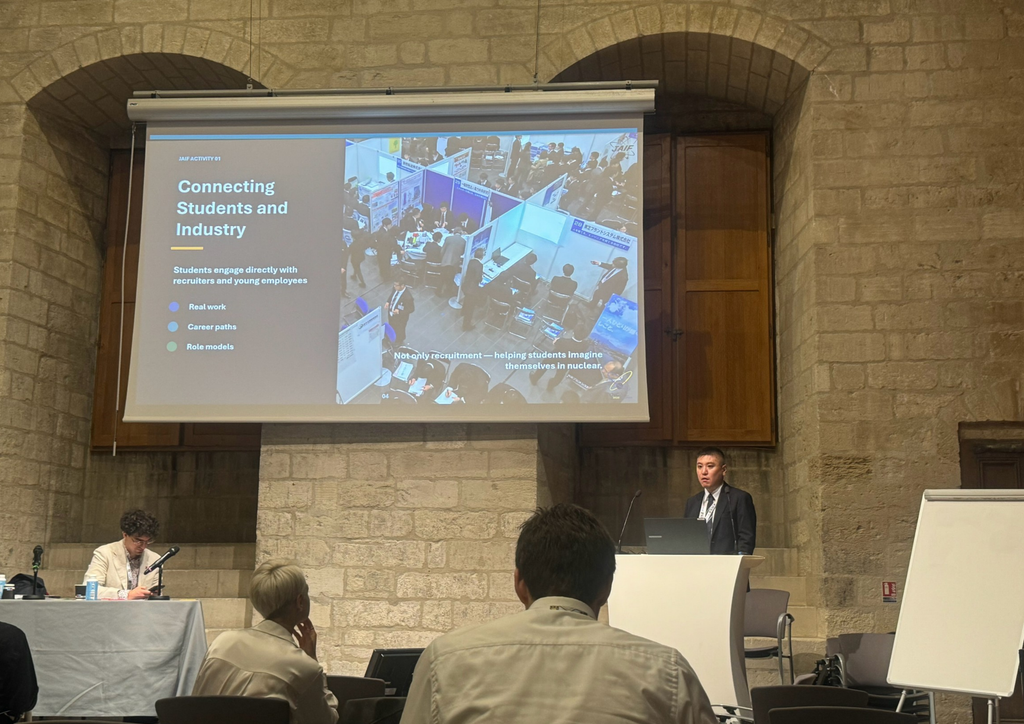


During one of the discussions in Avignon, the moderator gave the panelists a simple challenge: each had two minutes to name the biggest gap between nuclear’s technical evidence and its contribution to climate action.
The answers went in different directions. One focused on project delivery, another on financing, others on policy and communication. Rafaela Mondadori, an engineer with EDF, the French electricity company that operates most of the country’s nuclear fleet, chose a more uncomfortable word: selling.
That answer captured something broader about where nuclear is today. Interest is rising quickly. Governments are considering new reactors, electricity demand is growing, and nuclear has returned to serious discussions about climate, energy security and industrial competitiveness. Turning that interest into something useful requires far more than announcing new projects.
An executive from Orano Projets, the engineering arm of the French nuclear fuel-cycle company Orano, put the first challenge very plainly: delivery. Projects have to be safe, completed within a credible schedule and budget, and supported by people with the skills to manage increasingly complex construction.
He spoke about safety culture in a way that made it feel very concrete. Even during civil works, something as simple as holding a handrail was used as an example of the standards expected. His point was that nuclear cannot afford to treat safety as something that begins only when a reactor starts operating. The habits have to be there from the beginning.
The workforce issue is just as immediate. Orano Projets is recruiting more than 500 people a year, at the same time that much of the generation that built the large nuclear programs of the 1970s and 1980s has retired or is approaching retirement. Hiring new people is only one part of the problem. The industry also has to transfer the judgment and practical knowledge built up over decades before too much of it disappears.
The tools available to the next generation are changing as well. The Orano speaker described engineering moving away from a largely document-centred approach toward one built much more around data, product-lifecycle-management systems and artificial intelligence. That does not replace experience, but it changes how experience can be captured and used.
Rafaela came at the issue from a different angle. She argued that nuclear entered the modern climate debate with one enormous advantage: it was already capable of producing low-carbon electricity. When environmental concerns became central to global policy after the 1992 Rio Earth Summit, nuclear did not need to reinvent itself to become part of the climate solution.
In her words, “we got comfortable.”
Other technologies became very good at presenting themselves as answers to climate change. Nuclear had strong technical evidence, yet the industry often failed to put itself forward with the same confidence when governments and the public were searching for solutions. Rafaela described that gap very directly as a problem of “selling.”
Her other point was more technical, but just as important: nuclear plants do not operate in isolation.
France shows why. Much of its nuclear fleet was built to produce electricity steadily at high output. The European grid around those plants has changed as wind and solar generation have expanded. French reactors are now sometimes asked to reduce output when renewable production is high and increase it again when more nuclear power is needed.
From the outside, that may sound like a simple operating change. Inside a nuclear plant, it can affect materials and reactor chemistry. EDF has had to study those effects and adapt equipment and operating practices because plants designed decades ago are now working inside a very different electricity system.
Water availability raises another challenge. Rafaela spoke about conditions during summer months that differ from what some plants were designed around 40 or 50 years ago. Engineers now have to account for those changes when operating and modifying the existing fleet.
That is what she meant by thinking in systems. A nuclear plant sits inside a grid, a physical environment and an economy that continue to change around it.
The same logic applies to finance. An American delegate argued that nuclear needs better access to green finance and has to demonstrate its economic case against competing energy investments. Investors have to believe two things at once: that the electricity will be needed and that the project can actually be completed within a credible cost and timetable. Financing therefore depends heavily on confidence in delivery.
By the final round, the conversation had circled back to execution. Jadwiga Najder of Nuclear for Climate said the industry needed to become, in her words, “disgustingly good” at realizing projects: producing electricity and heat, supporting communities and doing it as seamlessly as possible for the people who place their trust in the industry.
The different answers fit together more closely than they first appeared. Financing depends partly on confidence in delivery. Delivery depends on people and capabilities that take years to build. A reactor that has been successfully constructed still has to work inside the grid and environment it joins. Even a technology with a strong technical case has to explain clearly why it matters.
Japan now faces many of the same questions.
Kashiwazaki-Kariwa Unit 6 resumed commercial operation in April 2026. At the same time, the government is already looking beyond restarts. More than 3 GW of existing nuclear capacity is expected to reach 60 years of operation before 2040, and replacing that capacity will take years of planning, licensing, construction and workforce development.
The supply chain is part of that problem. Japan has spent a long period with limited new nuclear construction activity, and the government has been trying to strengthen the domestic industrial base behind the sector. Restarting an existing reactor and maintaining the ability to build the next generation are very different tasks. Japan increasingly has to do both.
That is also where the discussion about people in Avignon becomes very concrete. Recruiting hundreds of young engineers is one thing. Giving them the opportunity to learn from people who have actually built, operated and maintained nuclear projects is another. If Japan wants nuclear to remain part of its energy system decades from now, that knowledge has to move from one generation to the next while there are still experienced people available to pass it on.
For someone my age entering this field, that makes the current moment feel much more immediate. The nuclear revival is usually discussed through government targets, reactor designs and investment figures. Behind all of those are people who still have to know how to make the technology work.
Japan’s next generation of nuclear professionals will inherit decades of experience from the people who built and operated the existing fleet. The challenge is to make sure that knowledge is carried forward while it can still be passed on.