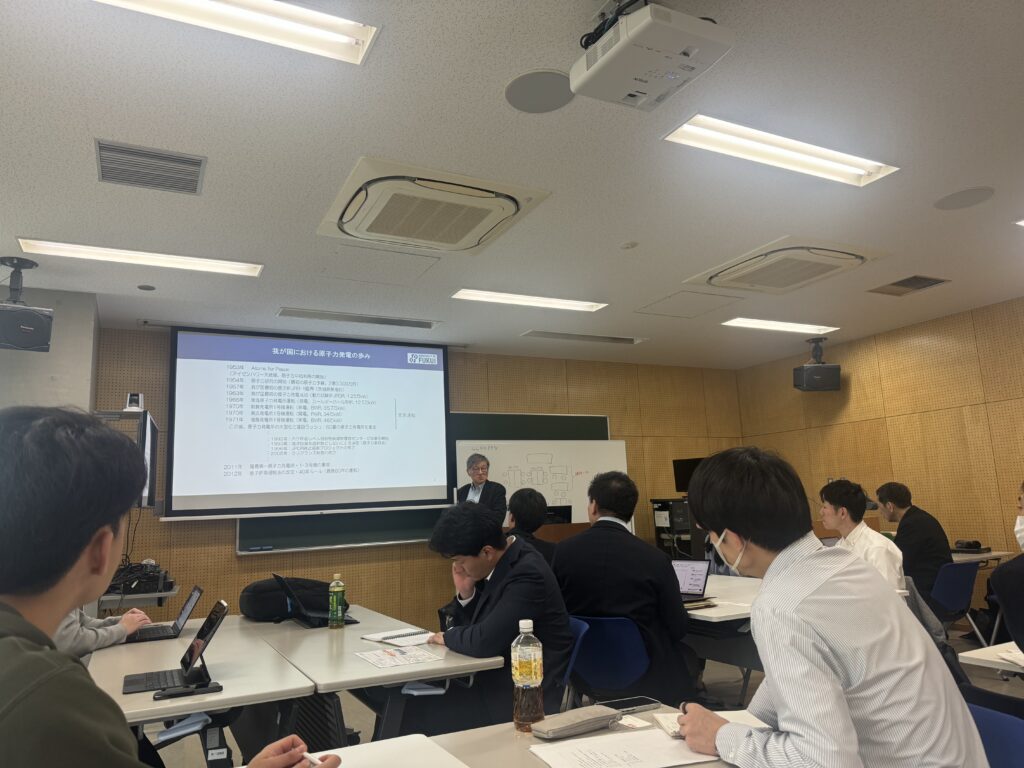


On the way to Fukui, someone mentioned Eiheiji Temple, where monks train for years in near silence, repeating the same routines until the rhythm becomes familiar. The image stayed with me as I arrived for a study session on nuclear decommissioning, the stage that begins after a plant stops producing power but continues to demand as much discipline and coordination as operation ever did.
Around me sat students, young professionals, engineers, and researchers, people who are gradually inheriting responsibility for this work. Decommissioning rarely draws attention. It unfolds quietly behind fences and within specialized organizations, progressing steadily over decades. Yet it represents the longest and often most complex phase of nuclear energy’s lifecycle, an effort that can extend across generations.
Fukui gave the discussion a tangible setting. Along the Wakasa Bay coast are plants like Mihama, Takahama, and Oi, which have operated for decades and anchored local economies through employment, infrastructure, and stable revenue. Many participants had personal ties to these sites. Their presence made the topic immediate, connected to places that continue to operate and to processes that are already underway.
The session focused on practice. Presentations moved through real projects and their lessons, linking technical execution with community impact. Younger participants were brought directly into the discussion, reflecting the need for continuity in a field where timelines extend far beyond individual careers.
One case study traced Japan’s first full reactor dismantling, the JPDR project. Beginning in the early 1980s, it stretched for about ten years and concluded with site restoration in the 1990s. At a glance, the project can be summarized simply. In practice, it involved handling and classifying roughly 24,000 tons of material, each component passing through measurement, documentation, and controlled handling. A key step was separating radioactive from non radioactive material, which led to the development of the clearance system that allows certain low level materials to be reused once they meet strict safety thresholds.
The project also introduced remote controlled dismantling techniques that are now standard. Engineers developed specialized cutting systems capable of working with high precision in areas where direct human access was not possible. Over time, the work took shape as a coordinated system rather than a single task. It required the movement and tracking of large volumes of material, alignment across utilities, regulators, and contractors, and planning decisions that would influence outcomes years later.
The discussion of Fukushima Daiichi added another layer. Research continues to examine conditions inside the reactors, as presented during the session, where materials behaved in ways that require further explanation. In some areas, molten fuel interacted with concrete to form new compounds, while the presence of seawater appears to have altered melting behavior and chemical reactions. These observations continue to refine models of how materials behave under extreme conditions, and they feed directly into planning for safe dismantling.
This means that decommissioning work advances alongside ongoing study. Planning depends on understanding what is inside the reactor and how it will respond during removal, while that understanding itself continues to develop through experiment and observation.
Examples from current projects, including Mihama, showed how this plays out in practice. A typical decommissioning extends over thirty years or more and is divided into phases that begin with preparation and decontamination, followed by equipment dismantling, reactor dismantling, and eventual site restoration. Decontamination can significantly reduce radiation levels, which in turn affects how materials are categorized and where work can proceed. Teams conduct detailed mapping to plan dismantling sequences that manage exposure and control contamination.
As components are removed, they are cut, packaged, tested, and stored. Some materials qualify for recycling under clearance standards, while others remain in controlled facilities for long term management. Even when high level waste is limited, the overall volume remains substantial, and managing it becomes an ongoing process rather than a discrete event.
At one point, someone asked who ultimately holds responsibility decades into the future. The responses reflected different perspectives. Utilities, government agencies, and specialized organizations all play roles, but no single answer fully defined the outcome. Responsibility extends across institutions and over time, reflecting the long lifespan of the materials themselves.
Toward the end of the session, the discussion turned to what comes next. Participants considered how decommissioning might develop over the next thirty years, including ways to improve material reuse, reduce environmental impact, and integrate the work more effectively with local economies. The conversation remained open, shaped by the understanding that each completed project contributes to a larger body of experience.
In Fukui, these questions connect directly to the region’s future. Nuclear energy has shaped the local economy for decades, and decommissioning forms part of what follows. It influences how sites are repurposed, how resources are managed, and how responsibility is carried forward across generations.
Nuclear energy spans a full lifecycle that includes construction, operation, and decommissioning. The final phase unfolds over long periods of time, requiring coordination across science, engineering, and policy. It continues steadily, often without visibility, shaping outcomes long after the plant itself has stopped.
The discussions on the first day stayed at the level of systems, how decommissioning is structured, how materials are managed, and how timelines extend over decades. The second day brought that into focus. Instead of diagrams and case studies, we were looking at actual facilities where that work is underway.
On the second day in Fukui, we visited the sites of the prototype fast breeder reactor Monju and the advanced thermal reactor Fugen, where decommissioning work is already underway.
Both reactors represent an earlier phase of Japan’s nuclear ambitions. Monju was designed as a fast breeder reactor, using plutonium as fuel and liquid sodium as a coolant, with the goal of producing more fissile material than it consumed. Fugen, by contrast, used heavy water as a moderator and was designed to make use of plutonium and uranium recovered from spent fuel. In different ways, both reactors were tied to the idea of a closed nuclear fuel cycle, where fuel could be reused rather than treated as waste.
Walking through the facilities, what stood out first was the scale. The structures are massive, but at the same time built with a level of precision that becomes more apparent the closer you look. Every pipe, every component reflects a system that was designed to operate under tightly controlled conditions. That same level of detail carries over into the decommissioning process.
At a nearby facility operated by JAEA, there was a full model of Monju, along with components that had been damaged during the sodium leak accident. Seeing those parts preserved in their original state made the incident feel less like something described in reports and more like a physical reality. The effort to investigate the cause, prevent recurrence, and pass down those lessons was clearly visible in how the material was presented.
What became clear across the visit is how much effort is required simply to take these systems apart. Decommissioning involves dismantling each component, separating materials based on their properties, and determining whether they can be reused under clearance standards or require long term disposal. This is not a single operation but a continuous process that depends on coordination across utilities, research institutions, and private companies. Even installing the equipment needed for dismantling is a complex task in itself.
Comparing past images of the facilities with their current state made the progress visible, but it also highlighted how much remains. Large portions of the structures are still in place, and the work continues step by step. The time horizon becomes very real in that context. These projects extend over decades, requiring consistency and sustained effort rather than speed.
The question of waste comes up quickly once you see the process in person. Decommissioning generates large volumes of material, and while much of it is low level, it still needs to be handled, stored, or processed appropriately. The issue is not only technical but structural. Disposal pathways are not fully established, and that uncertainty directly affects how the work progresses. In practice, this means that parts of the system continue to be maintained while decisions about final disposal remain unresolved, adding both time and cost to the process.
That point connects to a broader question about how nuclear systems are evaluated. Much of the public discussion focuses on safety, which is essential, but there is less clarity around long term cost and system level sustainability. Standing inside these facilities, the scale of what needs to be managed over time becomes more concrete. The economic side is not abstract. It is embedded in the physical work required to complete the process.
This is not limited to existing reactors. Even as new reactor designs and fusion systems are developed, the question of how to handle materials at the end of their lifecycle remains. The form may change, and the level of waste may differ, but the need to manage it does not disappear. That makes it difficult to separate discussions of development from discussions of decommissioning.
What the visit added to the earlier sessions was a sense of continuity. The frameworks discussed on the first day, logistics, material management, long term planning, are not theoretical. They are visible in the way work is carried out on site, in the equipment being used, and in the pace at which progress is made.
By the time we left, the scale of the challenge felt clearer, but so did the structure of how it is being addressed. Decommissioning moves forward through accumulation, measured steps, repeated processes, and coordination across different parts of the system. It is slow, deliberate work, but it is also steady.